Sunday, November 25, 2012

Spanish lessons in Guatemala

2000, 24 November, 2012. Onboard Gosling, Bahia Del Sol, El Salvador We have just returned to Gosling from Antigua, Guatemala. It has been 2 weeks of intense Spanish; well, as intense as 4 hours a day can get, 1 on 1 with an instructor, but with homework thrown in, the “intense” classification might just be appropriate, OK, we are over 60, so any brain drain over 20 mins is pretty serious….. Fran and Carol had arranged for the courses online at the Antiguena Spanish Academy. Initially we were a bit nervous as this was within weeks of the volcanic eruption of Fuego, just west of the town, and of the earthquake in Guatemala City. That one, and some of its aftershocks, had also been felt in Antigua.
Fuego (Fire) Aptly named but out of focus... We arrived in Antigua on Sunday night (2 weeks ago) after a long and grueling 8-hour taxi and mini-bus ride through the El Salvador and Guatemalan foothills. After a night in a cheap hotel we checked into the school and were assigned our homestay venues and our teachers for the course. The homestay system consists of a number of families who have been contracted by the school to provide room and board for their students. Our first family was the home of an elderly widow and her daughter who had 4 rooms available. We soon found out that the quality of food and lodgings varied considerably among the providers. Fran soon became unhappy with the food quality and we found the accommodations to be wanting. The bathroom sink drain leak and wet floor, the lack of hot water and the barking dog on the roof were sufficient for us to seek another location. Ken and Carol were in another homestay nearby and ranted about the place and, as luck would have it, there was a vacancy when we inquired. Problem solved: great food, comfortable accommodations and a super group of students, mostly half our age but it didn’t make any difference. Another student (in another homestay) almost got electrocuted when the showerhead caught fire. This probably requires a bit more explanation to those who have never taken a Latin American shower where the shower-head is an electrical appliance. It actually heats up the water as it passes through it, similarly to the instant hot water systems we are familiar with. No way would this meet the electrical code of anywhere north of the Mexican border. She was OK but later did feel a jolt as she shut off a bedside lamp. It was just her day…. On Monday of the first day we showed up at the school office, completed our registration and were assigned our own private maestras de Espagnol (teachers). We walked with them to another location, a park setting, chatting all the way, in what halting Spanish we knew so that the teachers could establish the level at which we had to begin. Neither of our teachers quit right away so we must have shown some potential. Every morning at 8 AM we would meet at the park, find our 2 chairs and table and slave away. By noon we were both fried, so after a homework assignment we both went our separate ways until the next day. We have to admit that we both actually know much more that we did 2 weeks ago. Our vocabularies have increased dramatically and verb conjugation is actually something we consider now. On the weekend we decided to visit the Mayan ruins at Copan, Honduras. It was another bumpy 6 hr minibus ride that began right after classes and ended after dark. We spent Saturday morning visiting the ruins with an English-speaking guide who explained in detail the history of the Mayans and purpose of the various buildings, the Mayan customs and traditions and so on. That really made the visit! I highly recommend to anyone visiting sites like this one to employ a guide. Without one the ruins are just a pile of rock; with one they become alive. The photos below show ruins that are much worse for wear than at Paleque (Mexico) where we toured last Feb. Most of the truly spectacular artifacts recovered from the archeological digs are in museums around the world, but some have been preserved in an adjacent museum where some of these pics were taken. Only a fraction of the existing ruin sites have been explored in this park. For those of you who have heard that the Mayan calendar is predicting the end of the world (or worse) and are considering entering a bunker on the Winter Solstice, it is a lot of crap. The date signifies the end of a Mayan era. One of many that was predicted centuries ago by their astrologers. Try a Google search for “Mayan Calendar End date”. There are some really good articles there including the Wiki site.
Temple ruins
Warrior Training Ground
Reconstructed wall panel showing a macaw god figure
The accurate location and reconstruction of a past mayan king's bed. Oh, come on, you'd have done it too!!!! The following day we toured a rescue bird sanctuary where hundreds of rescued exotic birds which cannot be returned to the wild are sheltered. Fran had her photo taken with several Macaws.
Fran, the bird lady. She found out later that while this was happening sand fleas were biting her ankles. Apart from the Spanish lessons and Copan there were other highlights worth mention: -we made lots of new friends. Arv and Belinda from Tasmania deserve special mention. If it wasn’t for Belinda, Arv would surely self-destruct as the Tasmanian Devil in the Looney Tunes cartoons is prone to do. Also of note were Jeri and John, an American couple taking time off from cruising their 50 ft steel trawler, currently in Rio Dulce. They are in Antigua for 6 weeks while John learns Spanish. Jeri is actually fluent in Spanish and teaches back home. She is spending the time learning to play the harmonica. We hope to catch up with them in the Caribbean next season; -We met Barry (Passat II) and his friend who were touring the area while Passat II is undergoing a refit. Between him and another couple we met on our course, Jerie and John Milici (MY Peking), who also have their boat at Rio Dulce we obtained a lot of detail about the area. This might be our final destination to store the boat for the summer season this season or next; -Shopping in Antigua was great from Fran’s perspective. We also discovered what is reputed to be the best rum in the world, Zacapa 23 yr old. We haven’t tried the premium Gosling rum yet so our jury is still out… - the town had more coffee shops than bars and Guatemalan coffee is very nice; - We decided to splurge for our last 2 nights and stayed in a beautifully appointed bed and breakfast, Casa Menta. It is run by a young Japanese couple who opened it just a few weeks ago; -on our last night we went out with a number of students for a final dinner and bar visit. On our way we discovered a specialty chocolate shop that provided a history lesson on the origins of chocolate and a demonstration of the manufacturing process. We were also able to sample the products of the various stages of production, a fascinating ½ hour accidental find; and -The volcano actually puffed for us on Friday morning, When we arrived back at the marina, Steve and Linda (War and Peace) were waiting for us with their tale of woe. When they arrived back from their Spanish lessons the previous week they discovered that they had been hit by lightning over the summer. Most of their electronics have to be replaced and they will be delayed a few weeks longer than expected. We were lucky to be spared as they were the closest boat to us in the mooring field. Just discovered that one of the cameras is defective. It took the photos but didn’t record them on the storage card. Bummer!!!

Friday, November 9, 2012

Another year, another adventure bigins.

0800, Friday, 9 Nov, at the buoy, Bahia Del Sol Up early today, before Fran for once. She seems to have had a good restful night. So, as they say, let them lie….. It is another clear and bright morning. It is already getting hot so the new fans I have installed will come in handy again today. The few hours of rain we had this past week appear to be the final remnants of what has been a very wet summer and the start of the gradual transition to the dry season. Our min/max thermometer indicated that the cabin only reached a max of 98F this season, however, the humidity would have made it feel much higher. We left last Thursday via Vancouver and San Francisco, so we had a leisurely day via the ferry and to Surrey where we met up with Bill and Janet (Optical Illusion, who will be catching up to us after we leave here, the boat is in Huatulco) and Ken and Carole (Nauti Moments) who graciously offered to accompany us to where the truck was to be stored for the winter and also drove us to the airport. They left the following day to join us. We flew with United and TACA, the predominant Central American airline. The TACA plane was a newer A-320 and the service excellent, much better than United. We arrived at 8 AM to a considerably hotter climate than we left. All of our baggage was there (whew) and we later discovered that only a bottle of contact cement had been removed by TSA. The going rate for a van taxi is $30, for the 40 minute drive, such a deal! It was with heavy hearts that we left Rosie behind this year. The airline industry is making it more and more difficult to bring animals as cargo. Also, after considering the areas we were heading to this season, it was getting increasingly difficult to plan pet friendly stops and inland travel. We’ll miss our alert dog but she is with very good friends who will undoubtedly teach her a bunch of new tricks and spoil her. When we arrived at the hotel/marina, Carlito was waiting for us with his panga to take us out to Gosling. He is Murray and Colette’s right hand man at Island Marine where Gosling and 8 other boats, (Including Nauti Moments and Warren Peace) have spent the summer. When we arrived onboard we were amazed at the sparkle and cleanliness. The crew had washed the upper-decks and even polished our stainless. When we opened her up Fran’s phobia of finding mold and mildew everywhere was eased. The boat had been aired out repeatedly during our absence and the interior had been wiped down several times by Murray and Colette’s crew. The fans, we had left on, also helped. There were a few closets that had a bit of mold but nothing serious. Fran’s vacuum packing of the majority of our clothes, bedding and dry goods paid off in spades. After getting the dinghy and outboard from storage ashore we were ready to start prepping for another season. We needed to get our bags unpacked and their contents stored in an already strained storage network. We must remember to take the time to get an inventory before we depart next spring. It is a common cruiser’s dilemma to bring lots of stuff from back home that really isn’t needed, especially clothing. Maybe if we were younger we’d remember what we had onboard form season to season. Next we had to get water onboard and start the process of putting up all the running rigging, sails, tending batteries and getting all of the items in Murray’s storage lockers, including all of the electronics back onboard. So far we have found a few items that have failed, probably from lack of use. One is the command microphone and the other is the charger-inverter that is, once again, not responding to a shore power input, the same problem we had 2 years ago and cost us about $600 to get repaired. Half of that was shipping costs to the factory in Minnesota….. So, it has been a busy week but we have had the time to socialize. Carole and Ken arrived, as scheduled, last Saturday and there are several other boats at the other marina that have, either just arrived or have spent her summer here. Among others are, Ideal 1, another Victoria boat, Timeless, Que Bella, Mita Kuulu, Blythe Spirit and Saucy Lady. A few boats left this week to continue their adventures, including Contento and Desmarais, a couple we had met in Guaymas in 2008. Yesterday was the first big shop. 4 couples shared a local mini-bus for the day and went to capital, San Salvador. The normal routing is a few hardware stores, a fabric supply store (where you can get Sunbrella for a low a $4.50/yd), a large shopping mall, Price Smart (Central American version of COSTCO), a large grocery store and back. We left at 8 and were back at 4, a long and expensive day but critical to our progress. We’ll do this again before we leave. Things are much more expensive in Costa Rica so stocking up here is essential. Sunday we are on our way to Antigua, Guatemala for our 2 weeks of Spanish lessons. We heard about the earthquake in Guatemala 2 days after it actually occurred. There was quite a bit of damage in the capital but Antigua was spared, as was the lake Atitlan area where Steve and Linda (Warren Peace) are doing their language training for another week. Once we get back from that we’ll be focused on preparations for our departure. We are aiming at the first week in December.

Tuesday, April 24, 2012

Countown to reality

22:40, Good Thursday, 5 Apr 2012, Anchored, Bahia del Sol Things are definitely winding down on Gosling. Much of our prep work to leave the boat for the summer is completed. Today Fran was sealing some of the foodstuffs we are leaving using her Food Saver. The vacuum sealer does an excellent job. We will be using a similar method for our clothing, bedding and towels when we get the bags in a week or so. Ken and Carole have returned home to BC for 2 weeks and have a list of items to bring back including the bags. Several boats are going through the same storage routine. Steve and Linda on Warren Peace are almost complete. They are at their summer mooring already and are well advanced. They will be leaving soon to take Spanish lessons in Guatemala before heading for home. There are still a number of boats that are prepping to continue down the coast for Panama. Tomorrow, Tom and Laurie on Camelot will be leaving and they will be followed by Hotspur and others as they continue their voyage. Ken and Carole have not decided whether they will continue this year or not. They feel that they are going too fast and missing too much so they are now considering leaving the boat here and continuing next season. It is still very hot during the day and cools down slightly overnight. We are at full moon and the highest tides of the year will be occurring next week. The current is 4-6 kts at times and actually gives anchored boats a bow wave and a wake. The locals seem to relish the heat. Conditioning must be the secret. Semana Santa (Easter week) has begun and the beach residences are full to overflowing. The resort here is sold out but we are spared the big crowds who would rather spend their time on the beach side of the resort rather than the estuary side where we are. 2300, 7 Apr 2012, same location What a light show we are having!!! Thunderstorms have been predicted for the next week and every day we have seen a build-up of clouds and some distant sheet lightning by nightfall. Over the last 2 evenings the thunder clouds have been forming closer and closer. Yesterday at about 5PM we saw a funnel cloud emerge from a big ugly black cloud just to the west of us and by nightfall we could see lots of lightning to the west. Well, tonight those clouds (minus the funnel) are overhead. At dusk we saw the first lightning and since then it has been a continuous show. So far it has been contained in the clouds above us and the thunder is muffled. It was absolutely still, not a breath of wind until a few minutes ago and now it is whistling through the rigging and making the awning flap wildly. I had to put up some frapping lines to keep the awning in control but that has only limited effect. 20 mins later: It is blowing 30-40 and raining like hell. Now we have forked lightning and real thunder claps. Rosie is hiding somewhere on the boat. She seems to find little cubby holes in the Vee berth when she is really scared. We weren’t completely caught by surprise but things are wetter onboard than planned. It was so hot that we waited to close the hatches until the last minute but fell asleep. Oh well, another lesson learnt. It’ll be hot and drier tomorrow. 1200, 8 Apr 2012 same location Everything is dry again but we will probably have a similar downpour tonight. We are in the transition period between the dry and the wet seasons. Jean (Mita Kuulu) says that this is the typical weather pattern for the transition period but it is a bit early this year. It has put quite a damper on the Semana Santa party-goers. For many this is their last day; tomorrow is a holiday only for the federal employees so most of the holidayers are on their way home. Soon we will be back to normal at the resort with only the cruisers using the facilities and keeping the bar staff employed. 2300, 22 April, 2012 At Colette and Murray’s Mooring, Bahia Del Sol I didn’t think I’d have much to write about during the last few weeks of preps to depart but we have had another interesting event to break up the monotony. Some of you may remember an incident I wrote about 3 years ago, about a microburst that hit us with high winds while anchored in Barra De Navidad. Well, a case of Deja-Vu last night. In late afternoon we had watched the build-up of nimbus clouds to the north of us, nothing abnormal about this and getting to be quite commonplace. We were expecting a light show and were not disappointed. As dusk arrived there was a lot of distant sheet lightning to the north. By 8 PM the wind picked up and rain started to fall. Our dinner guests, Ken and Carole, fresh from their 2-week trip back to BC, decided to get back to their boat before it got worse. Luckily for them they made it with minutes to spare before we were hit with what must have been another microburst. Our wind meter started at 30 kts and during the following 30 minutes it rose steadily reaching 73 kts at its peak. Our mooring field has 8 boats in it and 5 were swept away, with their mooring clumps. I was watching a Beneteau 45, next to us, lit up by almost continuous lightning as it wind-vaned beam on to the wind and begin its drift. An amazing sight! Luckily we had taken precautions when rain seemed likely but nothing prepared us for the maelstrom that followed. Our only loss was the gas tank from the dingy and a tear in our canopy. Other boats weren’t so lucky. 2 boats from our group drifted into each other and caused some damage to wind vanes, pulpits and railings while others suffered mainly torn sun shades and canopies. As soon as the wind had died down I was able to go out with Carlito,the caretaker of our mooring field to assess the condition of the boats. We discovered 2 local fishermen hanging on for dear life on the mooring cable of one of the boats. Their wooden canoe had flipped over and, lucky for them, they were upwind of the mooring field otherwise it would have been a much more tragic outcome. Boats at the other mooring field and the docks weren’t so lucky. One got a few small holes punched into her from an anchor on a drifting boat that broke her mooring line. One of the anchored boats, a J-36, ended up on a concrete dock and was severely damaged, and is now considered a write-off. Docks were damaged, cleats pulled out and panicked owners did everything they could to minimize damage. This morning we were able to better assess the damage. Cruisers are a remarkable breed. They have an inbred spirit of cooperation and are always willing to assist where assistance is needed. It certainly showed today as everyone pitched in to help those who were worst hit.
Tolerance - write-off
Island Marine's dock We have only 4 more days to go. We hope that will be the last excitement before we leave. Ken and Carole (Nauti-Moments) will be joining us in the moorings in the next few days. We are close to completing our preps. Fran has been packing things to go and things to stay. Her vacuum packer has seen a lot of use. She has also been vacuum packing large items using special bags that Ken and Carole brought back. She uses the vacuum cleaner for those. We are not taking any chances on mold so any linen, clothes, pillows or anything else liable to be affected is getting bagged. All surfaces on the boat are being wiped with a vinegar or chlorox solution. To back these precautions up we have a wonderful staff here at the moorings that will open up the boats regularly to air them out and check for excess moisture. Yesterday we were finally able to confirm Rosie’s flight arrangements, however, a SNAFU with the airlines will have her arriving 3 hours after we do in Phoenix. 2330, Same location Just a few minutes ago I was sitting on the bow in one of our folding chairs just enjoying the ambiance. There is a crescent moon setting directly in front of us. The tide is ebbing, we are pointed west, the current is about 3 kts and is burbling at the mooring chain. The only other sounds are dogs barking and occasionally, the sound of a small boat engine as they zip up and down the estuary. On the starboard side the shore is dark. There is no electricity supplied to the island so all we can see are small solar lights and the occasional bobbing flashlight as someone walks along the path by the shore. A few people on the Island have generators but by this time they have shut them off and gone to bed. The other side of the estuary is the narrow strip separating us from the ocean and the main road leading to the Pan-American highway. They have electricity on that side so there are lots of lights. With the right wind and tide we can hear the sound of the waves crashing on that shore, but not tonight, it is absolutely quiet. Earlier you could hear the bus announcing his passage by a blaring horn. Somewhere in the dark is the dock where our ever-faithful guard is watching over us. Every once in a while he turns on his million candle power spotlight and sweeps the beam over all of the boats in his charge. There is a slight odor of smoke in the air probably from sugar cane fields or trash burning. Since the storm there has been a lot of that. This is our last night aboard so I have to soak it in as best I can. It will be another six months before I can do this again. Tomorrow we finish our preps onboard, give our keys to Carlito and get a ride from him to the resort where we will spend the night, or part of it. We have to be at the airport by 5 AM so it will be a short night. It has been a great season and, as usual we have enjoyed our time on Gosling. We have left the Mexican comfort zone and are on track for Panama and what lies beyond. We’ll be leaving Gosling with some trepidation. This is our first time leaving her in the water but we will have the Island marine staff looking after our baby. This is probably our last entry of the season, Hope you have enjoyed reading about our adventures. Hope you follow us next season. Cheers, J-G, Fran and Rosie

Friday, March 30, 2012

Sitting tight in Bahia Del Sol

22:00 Tuesday, 23 March 2012 At anchor, Bahia Del Sol, El Salvador
Another blistering hot day in El Salvador. It is 10PM and it is still 80F in the cabin. Thankfully the breeze we have during the day makes it feel a bit cooler but it has died and now the breeze is a manufactured one – 12 V fans.
Fran and I have had another busy day. We went to San Salvador using the local bus system. What an experience! We left mid-morning to make a 2PM dental appointment in town for Fran. We caught the local bus at the resort gate and rode it for an hour to the highway junction to the city where we transferred to another similar bus for another 45 minute run. These buses are mostly of the old Bluebird school bus variety, most likely recycled from the US. They are all modified to carry more passengers and most are worse for wear, however, they run on time and they are an efficient mode of transport. One weird (to us) custom is for the driver to allow hucksters aboard at various stops or at the station before departure. These people sell anything from gum to candy bars, fruit, religious calendars, cookbooks, pastries, chips (banana, potato or coconut with your choice of sauerkraut, salt and hot sauce), plastic bags of water (actually factory filled and sealed 1 litre bags – bite off a corner and drink) and a host of other items. We bought a dollar bag of strawberries and peanuts (complete with a small bag of hot sauce and lime juice). When in Rome..... we were disturbed to see that any and all trash is thrown out of the windows adding to the litter along the roads.
Other than the trip there and back the event wasn’t noteworthy except that there was nothing wrong with Fran’s teeth. She thought she had cracked one. We also discovered Central America’s version of Costco – Pricesmart. It will be a very good source when we re-provision in the fall. Lunch was at Pollo Campero, a Central American chain that brought inexpensive fast food (chicken in this case) to the masses. The chain is expanding into the US and Japan.
Our trip to Guatemala was very pleasant. It was an expensive outing but, this time, we let someone else do the driving. We managed to have Rosie bunk in with Chris and Alan on Beverly-J for the time we were away so that freed us up for a more relaxing time. Once again we teamed up with Ken and Carole (Nauti Moments) and took a 3-day tour with driver and tour guide. We spent a lot of time driving from place to place but the van was air-conditioned and very comfortable. Our tour guide, Benjamin, spoke good English and had much to tell us about El Salvador and Guatemala. It is hard to believe that both countries were rife with political unrest within the past 20 years. Benjamin had some first-hand accounts of some of the horrifying events that unfolded in the early 1990’s and how the US (CIA) came to the aid of both countries to stall any further incursion by the Soviet hordes...... We noticed a big difference from Mexico with the amount of US influence in both countries. Every fast food chain is represented and US aid money is obvious everywhere. We did saw a sign in Atitlan expounding the aid provided by Canada for small businesses.

Sign in Atitlan about Canadian Aid to Small Business

Crossing into Guatemala was a much easier process than what we have experienced with our check-in and out of Mexico. It took only a cursory check of our passports and a stamp and we were on our way. Our first stop was Antigua, a beautiful colonial town, founded in 1543 and a UNESCO World Heritage Site since 1979. The town is nestled between a trio of volcanoes of which Fuego is still active and emits a steady stream of vapour. The city has 38 churches but only a few were rebuilt after a devastating earthquake in 1773 that destroyed most of the city. We met many Europeans and had a fun time wandering the streets around the square and selecting a restaurant for dinner. One, featuring lamb, venison stew and another meat stew we couldn’t identify, drew us in. J-G, being the “gotta try it once” guy, went for the latter which actually turned out to be the most succulent of the 3 choices. It turns out that the meat is of the sheep family but one sporting hair rather than wool. After a night at a very nice hotel (Hotel Carmen) we spent a few hours touring the town before heading off to Lake Atitlan. We visited a jade factory, a native market but were turned away from a very scenic hotel by a bunch of serious looking guys in suits, sunglasses and ear-pieces. It just so happened that Antigua was hosting the presidents of the Central American countries for a meeting on Drug control. As we drove out of town we saw hundreds of police and military that weren’t there the previous afternoon.

Fuego Volcano from Antigua


Antigua cathedral with hand-laid coloured salt crystal carpet and fruit/veg offerings for Easter. Alter is covered by a 3-D scene which is changed daily.


School girls and religious procession, town square, Antigua

Our next destination was Lake Atitlan, a 128 sq km lake in a sunken volcanic crater, 1000 ft deep, surrounded by 3 other volcanic peaks. We spent the afternoon taking a boat across the lake to visit 3 isolated villages, San Juan, San Pedro and Santiago where people make traditional native crafts, now exclusively for the visiting tourists. At the last stop we were getting late in the afternoon and the peddlers were getting anxious to make their last sales. One lady followed Fran for 3 blocks trying to sell her a skirt. She finally wore Fran down but settled for a fraction of her initial asking price, which was probably what she expected to get anyway.

Look who's afraid of a bit of spray - fresh water spray.


Incredible sunset scene over lake Atitlan with storm clouds brewing overhead.

The following morning we went to Chichicastenango, an indigenous market town where everything we had seen in the previous 2 days and much more was for sale. The roads in the mountains were bordered with lush fields and terraced gardens where a wide variety of market crops were being grown. This was a marked difference from what we had observed in Mexico on our trip to Palenque where the natives eked a living growing corn and coffee everywhere there was a patch of soil, no matter how steep the hillside. We all wondered whether this was another instance of US aid at work.

Shopping in Chichicastenango


Ken and Carole - Chichicastenango market

Well, we are back on the bay and are slowly gearing up to leave at the end of April. We have now committed ourselves to an Apr 26 departure. We have had some issues getting a flight where we can take Rosie. Finally yesterday, after several frustrating attempts to get answers from United Airlines, we got the green light but it will not be easy. She needs a vet’s checkup within 5 days of departure (at a vet in San Salvador), must be weighed at the airport the previous day and must arrive 3 hours before our 0630 departure time and all this will have to be done by taxi. When we arrive in Houston (on our way to Phoenix because they don’t have pressurise cargo holds on the planes that fly directly to Tucson) we need a minimum of 3 hour layover so that she can be checked out by US officials. What a hassle!!
2030, Friday, 30 March, Still anchored
Over the last few days we have had some leisurely lazy days. Mornings are projects times, before it gets too hot. We have been setting up a sun shade using fence coverings used at the Winter Olympics in Vancouver. The panels are 6’ by 40’ and we have 2 of them, obtained from a provincial surplus outlet in Victoria. All we have to do is adapt them to the boat by cutting out sections where the rigging interferes with the layout. Easier said than done working on a sailboat. In the meantime we have set up an old shade we found on the boat when we bought her. So far that is working well so the other project has taken a back seat. Apart from walking Rosie, cooling off in a pool that is just below ambient temperature and waiting for Happy Hour at poolside, chatting with other cruisers there isn’t much exciting happening. Every few nights there is something special happening. Tonight there was a wine tasting followed by an Italian dinner at the resort but Fran is under the weather so we opted for a nice quiet spaghetti supper onboard.
Today J-G went on a short excursion to a nearby town with a bunch of cruisers to participate in a school fruit festival. The kids and parents welcomed us graciously and we enjoyed a few hours of entertainment and fruit tasting. J-G added 3 more exotic species to his list.
Next week is Semana Santa here and it is promising to be an absolute ZOO. The week before Easter is Latin America’s Spring Break. The management has all their units rented out as do most of the resorts and hotels along the strip. The waterway we are anchored in will be very busy so Rosie will get her exercise chasing watercraft from one end of gosling to the other. Beer tents have popped up all down the road and 2 circuses have set up camp a few miles away. This would be a good time to be away but it will be crazy everywhere so we will just have to hunker down and survive the onslaught....

Wednesday, March 21, 2012

Over the bar into San Salvador

2000, Tuesday, 20 Mar, 2012 At anchor, estuary Jaltepeque, El Salvador
Another blistering hot day is over and we are relaxing in the cockpit. Fran is reading and J-G is writing the blog, trying to catch up on the past week’s events. It is absolutely quiet save for the distant roar of the surf on the other side of the peninsula. There is a cool breeze blowing and it is really quite pleasant after another scorching day. Every once in a while a dinghy or a panga goes by and Rosie gives them a few warning yaps. Early this morning we had quite a downpour, a rare event here at this time of year. We both had to hustle to close the hatches before getting everything soaked. It was nice to take a shower under nature’s own for a change. We are hearing that Eastern Canada is getting a very early hot spell, in the mid-20’s.
The highlight of the passage from Chiapas was the entry into the estuary over the bar, or Boca Conrdoncillo, as it is called locally. We all arrived at the waiting area well ahead of time and waited for the tide to run its course. Just before the end of the flood our escort jet-ski, driven by Rogelio, one of the marina staff, and Mita Kuulu’s Bill riding shot gun, arrived through the surf line. Last minute instructions were given, engines were run at full throttle for a few minutes to ensure we had lots of power and all hatches were shut and sealed. In Gosling, J-G took the precaution of tying Fran to the wheel (she was driving) and Rosie to her bed below. We all watched as Warren Peace passed through and then it was our turn. With Rogelio expertly driving the jet-ski beside us and Bill giving us directions by radio, Fran floored it and we entered the maelstrom. J-Gs running commentary to Fran as to the state of the rollers following us in and which way to adjust the helm to stay perpendicular to them can be heard in the video that he was taking (unable to copy here). Fran compared it with coaching through childbirth.... The actual crossing was much easier than we expected. We were picked up 3-4 times by huge rollers and surfed one in for 15-20 seconds, then it was over and we motored into a much calmer estuary over to the marina and tied up, changed our shorts and, no, it wasn’t that bad.... Fran did have a small bottle of Champagne to celebrate the crossing and our arrival at our final destination for this season.
Surf's Up

Yahoo!
Kuan Yin 1 had a better ride.

Good drive Fran!!

We heard later that the conditions at the bar were about as bad as it gets and that the previous day was worse. One boat, Serendipity, was nearly rolled as they caught a bad wave the wrong way. They also had left their main cockpit hatch open and had a mess to clean up. They also lost an outboard. Bill takes photos of all boats entering and leaving so we all have photo souvenirs of our exploits.
Once we were settled in and everyone was tied up safely we headed up the dock to do the entry paperwork at the port office and immigration. This marina/hotel complex has both services integral to its organisation and it was a fast and efficient procedure, and cheap as well, compared to the Mexican entry/exit routine. The first document we signed was one warning us not to bribe the officials... How refreshing!!
The marina at the Bahia Del Sol Resort (RCI affiliated) is the host for the Rally and is the centre for all the activities from the opening day (17 March) to the closing event (29 April). They work on a resort system where all is charged to your boat name. Bills are paid weekly and they welcome credit cards, another refreshing change from Mexico. Another important feature of El Salvador is that they use the US dollar as their currency.
The local area is quite “desolate”. Apart from the hotel and its grounds there isn’t much to see locally. The big city is San Salvador and it is 90 minutes away. At the opening ceremony we were welcomed by numerous officials that want us to encourage others to visit this country. We will get a chance to see more of it soon. We are going on a 3-day tour beginning Friday. We also met up with Colette, our friend from the Maple Bay marina who, with her husband Murray, own the mooring facility where we will be leaving Gosling for the summer. She delayed her trip home to be able to see us after we arrived. They have a lovely little place on the estuary with an A-frame that Murray built, surrounded by fruit trees, mangoes, olives, cashews and others. They have a dedicated staff that will be looking after our boats during the wet summer season to ensure we do not get a mold problem below decks.
Beach walk

We took advantage of being at the dock for 3 days to get most of our preps done for storing the boat. All the sails have been washed and bagged. Most of the running rigging has been removed, washed and replaced with chase lines for the summer.
We have all been amazed at some of the new plant life we have been seeing including cashew nut trees, new varieties of mangoes, kapok trees and others we haven’t been able to identify yet. Cashews are an interesting crop. As you can see from the photo, the nut is an appendage to the fruit. The fruit is edible but an acquired taste. The cashew is harvested when the fruit is ripe and must be roasted twice to remove the outer toxic shells. No wonder they are so expensive!
Cashew below the parent fruit

Kapok pods. Similar to a milkweed.

More when we get back from our trip.

Thursday, March 15, 2012

More inland travel and to El salvador: Final desination for 2012

Tuesday, 13 March, 2012, At sea, on route to Bahia Del Sol
We have departed Marina Chiapas and are on our last leg to Puerto Del Sol. We expect to arrive at the entrance to the bar at high tide at about 08:00 on Thursday. The winds are light and we don’t expect to make much headway under sail but we have factored in some extra time in case the wind does come up. We are in company with Tension Reliever, Warren Peace, Quon Yin 1, and Nauti Moments. Several boats left yesterday and more will leave over the next few days.
It has been a busy week. We were able to get away for a 4-day trip inland after all. Many thanks to Carole and Ken for insisting that we all go together and working hard to find a solution. We finally found a car to rent, a small Chevy rattletrap, the only choice available with good air-conditioning. It was relatively cheap and there was space for Rosie but she insisted on the door side of the rear seat forcing Fran to the “hump”.
The drive up to Palenque convinced us that we would never attempt such a thing again. The road up was very long and wound through 2 of the coastal mountain ranges. The worst aspect was the “topes” or “sleeping policemen”, those humps in the road designed to slow down traffic. Well, they certainly work! We had to slow down to a near crawl to go over most of them. The afternoon sun and shadows made it difficult to see some of them but after bouncing off the roof a few times we became extra vigilant. Another feature of the topes worth mentioning is the “opportunity commerce” common in many of the villages we passed through. As cars slow down to negotiate the bumps, people, mostly children approach them selling anything from fruit, tortillas to trinkets. At two places on our return trip there was a string barrier erected as we approached a tope and several adults and children came out of nowhere. At another a young girl jumped in front of the car as we were negotiating some very rough spots and took a lot of convincing to move out of the way; we weren’t stopping.
Road barriers by roadside sellers. Note the string.
Other road hazards - landslide damages
A common sight along these back roads are the “collectivos”, small privately owned vans that pick up passengers along and drop them off at their destinations for a small fee. This is a valuable service for the outlying areas where native people subsist on farming small holdings of coffee and/or corn. Most live close to the poverty line and do not own vehicles so this is their only way of transportation.
By nightfall we were still driving along the serpentine roads, crawling over topes and slowing for areas where previous washouts and landslides had been roughly repaired. The area we went through is also where the Zapatista uprising occurred in the late 90’s. Our copy of the Lonely Planet (2002) still warned of civil unrest and hold-ups along these roads. Today there are numerous military checkpoints that are another cause for delays.
We finally arrived in Palenque at 2130, after almost 12 hours on the road. We found Margarita and Ed’s hotel, highly recommended by Janet and Bill, at the entrance to the park gates.
Margarita and Ed's hotel
For 400 pesos / night we had an air-conditioned room in a 6 room building located in serene jungle like setting. Rosie wasn’t welcome so she slept in the car. There are several other hostels and small hotels close by but the jungle affords privacy. There were many people staying among the various accommodations, a very international and diverse gathering. Many were young adults, modern bohemian/ hippy types with their dreadlocks, baggy pants, bongo drums and huge back packs. Our son Mike had passed through here 12 years ago and this would, indeed have been a comfort zone for him.
The following morning we headed to the Mayan ruins of Palenque. These 500 (plus) buildings are spread over a 15 sq km area and date back to 250 BC to 900 AD. They are located in a jungle setting where the people carved out lush fields out of the bottom land fed by several watercourses. Only a small percentage of the buildings have been excavated. Unlike the Aztec and Zapotec sites Palenque had no gold and silver treasure so it was ignored by the Spanish conquistadors. It was rediscovered in the late 1700’s and in the following century it was claimed to be the lost Atlantis and by others, an extension of ancient Egypt. It wasn’t until the mid-1900s that the real discoveries occurred with the unearthing of several crypts with semi-precious stone offerings. Jade appears to have been an important commodity and many of the skeletons were adorned with jade death masks. Our guide through the ruins was very informative and pointed out many features that would have been missed had we been on our own. Several buildings still have original murals and inscriptions. The Palace (El Palacio) featured many rooms with murals and a small courtyard where frescos of captives were still in good condition after 2 centuries. The tomb of the Red Queen with its cinnabar red stains is still visible in its original location. Pakal, one of the more notable royal had his tomb built during his 90 year reign. The story of the discovery of his tomb in 1952, deep in the foundations of the temple, could have been the subject for an Indiana Jones sequel.
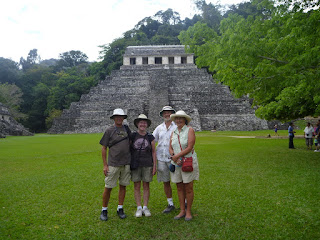
Temple of the skull- Palenque


Temple of the inscriptions - Palenque
Unexplored building - Palenque

Frescoe still in good condition after centuries of exposure

We were told that howler monkeys are quite common on the site but during our visit they were off duty. Our guide explained that when Jurassic Park was being conceptualized the creators were at a loss for a sound effect for the dinosaurs in the movie. When they heard the call of the howler monkey they immediately decided that the sound was what they wanted. We were able to confirm that the next morning when we heard some calling near the hotel just before dawn. Fran also got to see a Toucan spotted by some bird watchers.
We had hoped to also see the ruins at Yaxchilan but that would have been another full-day adventure using a guide service. Part of that trip involves a river boat ride up into the jungle on the Mexico/Guatemala border. The ruins at Bonampak are also close to that site. We had also intended on seeing the waterfall at Misla-ho but that would have involved driving the rattletrap over 10 kms of dirt roads.
We left Palenque early on our third day and headed back into the Sierras to San Cristobal de Las Cruces. On our way back we stopped at Agua Azul, a beautiful set of falls with a river the colour of turquoise due to the sediment it carries. We endured another 5 hour bone jarring drive over a multitude of topes but in daylight this time.
Agua Azul

We arrived in San Cristobal (alt 2100m) in early afternoon. This is a beautiful colonial town that was founded by the Spanish in 1528. It is now an artsy and bohemian community where hordes of tourists, many of them European, flock to experience the modern culture of Mexico. The many bars and restaurants are alive with people from early afternoon to late at night and the indigenous people are everywhere plying their souvenirs. Many of these are people expelled from their villages for turning protestant under the influence of foreign evangelical missionaries and live in makeshift colonies on the outskirts of town. We found a very nice little hotel that allowed Rosie to stay (as long as she didn’t go onto the bed). We dined in a Lebanese/Indian/Thai restaurant owned by “Liz” a displaced New Yorker, who we met just outside our hotel. We later discovered that she is the daughter of Ben Gazzara and Ann Rule. The climate at this altitude was quite different from what we have been used to and, thankfully, we had been pre-warned to bring warm clothes.
Young native souvenier seller carrying brother

The next morning we boarded our beater and drove back to Puerto Madero along the main highways and toll roads. It took us 5 hours but we had only a few topes to deal with and there was very little traffic. It was a very pleasant drive compared to the drive up on day one.
Before departing Mexico the formal exit paperwork must be completed. The final product is the “Zarpe” which must be presented at the next port of entry. In Ensenada, where we did our entry procedure in 2008, it only took a few hours. Everything was done in a single location: immigration, Port Captain and bank payment services. Puerto Chiapas is not organised like that yet so we were in for a long day. The Port Captain is close by, but Immigration is at the airport, 12 km away and the bank they use is in Tapachula 25 km away. The marina is expected to simplify this procedure but for our group of 9 Enrique’s right hand man, Memo, was tasked to drive us and walk us through the procedure. Even with Memo’s help it took us most of the day but finally we had our Zarpe in hand and it was time for another round of cocktails on the dock, a farewell to Mexico occasion (as if we needed a reason!)
The following morning the final boat inspection was carried out by the Port Captain’s staff and the navy (dog included) and we were cleared to go. Just after 8 AM we slipped our lines from Mexico and headed out on our final passage of this season and to a new country.
1300 Wednesday, 14 March 2012, At Sea
We are sailing in a beautiful 12 knot breeze on a broad reach about 15 miles from the Guatemalan coastline doing 6.5 kts. We have had a great day of sailing, one of the best this season. This morning we attained 7.5 kts on a close reach, the best we have ever done on that point of sail. We do have a problem though. It is ironic but we are going too fast to make our ETA at the bar tomorrow morning. We will have to shorten sail soon and adjust our sped to arrive by daybreak, a difference of About 4 hours at this speed. Within the next few minutes we will be entering the territorial waters of El Salvador. Guatemala is the first country we have bypassed without stopping. We’ve seen a few turtles and dolphins and a new bird for Fran, a Cook’s Petrel who tried repeatedly to land on our solar panels but kept sliding off; cute little guys. She has been keeping count of all her new sightings.
Sunrise over the mainland

0510, Thursday, 15 March 2012. Approaching Bahia Del Sol
It has been a good night with some sailing earlier but the wind has died and we are back to powering. We are an hour away from the entrance to the bay. There are 5 of us congregating at the mouth of the bay for an entry sometime between 6:00 and 8:00. We are expecting some kind of watercraft to come out and guide us through the surf line. This has been a source of trepidation for the past few weeks. We have seen photos of other boats surfing in with the swell as it builds over the bar entrance. We have had the experience already, albeit not a pleasant one (see: Knockdown at San Blas – You Tube). Lots of boats have been through this so it shouldn’t be all that difficult and, unlike San Blas, this will be a straight, down sea approach. There should be some good photos.
I will try to get these 2 blog entries away soon after our arrival. Hopefully the bandwidth will be suitable for the photos I want to include.
Note,2130 same day: good connection at the marina/hotel bar. Here for a few days before moving to the anchorage.

Last stop in Mexico and inland travel

0800, Thursday, 1 March 2012 At Sea from Huatulco to Puerto Madero (Chiapas)
We have been at sea for almost 22 hours since leaving the marina at Huatulco. We are now passing through the infamous Tehuantapec, renowned for its sudden and very high wind conditions, often gale to storm force. They are predictable and sailors transiting the area are always watching the weather sources for calm periods. This calm began yesterday and is supposed to last till Sunday. The land mass is the narrowest point between the Caribbean Sea and the Pacific Ocean. It is also very flat so the hazard is the spill-over wind from the Caribbean. Within a 6-hour period on Sunday afternoon the winds are expected to go from near zero to over 45 kts. The seas created by these winds have short periods and are very steep so it is not a pleasant experience to be caught unawares.
We left the marina yesterday at mid-day and went to anchor in a small bay just to the east of Huatulco where we cleaned the bottom of the boat and made sure that the propeller had no growth on it. We expect that this will be more of a motorboat crossing so we want the prop at max efficiency. There were several resorts on the beach and we had several swimmers come out to say hi and tell us that they were from Canada too. Seems to be a very popular area for Canadian tourists and our Canadian ensign is a dead give-away.
It looks like we are in the lead group of a dozen or more boats headed for Chiapas. We are in company with Nuati Moments, Warren Peace, and Hotspur. Not too far behind are Serendipity and Taking Flight. Several other boats left this morning.
It has been an enjoyable trip so far. As predicted we are motor-sailing most of the time. We departed the bay in mid-afternoon into a rough sea, the residual seas from the previous gale but by sunset it had calmed down and stayed calm for most of the night. Just before sunrise a northerly wind came up and we were able to turn off the engines and sail for a few hours. We expect it to die soon and we have to make good 5-Kts to arrive at Chiapas during daylight hours. There is a 1.5 kt current against us at the moment so pure sailing in these light conditions will soon be out of the question.
This area has a remarkable diversity of marine life. Yesterday we saw numerous turtles, a whale and many rays doing the flip flop dance that we thought was unique to the Sea of Cortez. We’ve caught several Mexican Bonitas and threw them back. Hope we get a decent catch soon; a nice yellow tail would be perfect for a dock party when we get in.
0600, Friday, 2 March 2011 25 miles to Pto Madero (Chiapas)
Another quiet night of motor-sailing down the coast. The winds have remained light and right on our stern all night. Over the past 18 hours we have made good time and have recovered for time lost due to the counter-current which, now seems to have dissipated. At this speed we should be tied up and secured to the dock by noon. It is going to be another hot day. Yesterday it got well above 80 in the cabin. The max side of our min-max thermometer is steadily being pushed to new highs. We have been told that it should ease soon and even drop a bit as we head further south.
We are still in company with Nauti Moments and Hotspur. Warren Peace is within 5 miles and there are 5 other boats within VHF range who checked in yesterday at 1800. The remainder are farther back and will probably not arrive until tomorrow.
0800, 5 March 2012, Puerto Chiapas
We are settled in to the marina at Chiapas, or Puerto Madero as it was known until a few years ago. J-G was here 28 years ago with Oriole for fuel on its way to Quebec City. Little has changed in the outer harbour but now there is a lot of work going on improving the facilities to accommodate cruise ships and larger shipping traffic. Marina Chiapas has been built from scratch over the past 2 years. It is not officially open yet but Enrique, the manager wants as many boats as he can get to test the services and provide feedback so he can make improvements. The government hasn’t given its final approval yet so power is still not connected and until that happens there are no fees to be paid, except for port usage fees of approx 75 pesos/day. Cruisers like anything that is a bargain! On Friday Enrique is heading for Texas to buy an 80 ton travel lift for the marina. Apparently it is in a field well inland and owned by a former boat owner who decided to buy his own to handle his yacht but he has sold the yacht and has no longer any use for it. What a find and he is getting it at a bargain price.
Our numbers here have grown. Most of the group that was at Huatulco are here now and it is like being with a large family. We have been joined by a couple of North-bound vessels waiting out their turn to cross the Tehuantepec . Yesterday Lion’s Paw arrived from a year in Central America and, a Canadian boat, Feel Free is northbound towards BC on the last leg of their circumnavigation. Starfish, a Swiss flagged Nordhaven 55 cruiser owned by the former European PADI diving training representative for all of Europe is also here.
The marina is truly a marvel. Enrique was the project manager for the Singlar marinas at La Paz and Huatulco . After working for Fonatur/Singlar for many years he became frustrated at the level of bureaucracy and incompetence he had to deal with and quit. Sometime later he was approached by a representative of a consortium of wealthy businessmen from Tapachula (the closest big town, pop >800K) and asked if he could build them a marina in Puerto Madero. He promised them a completed project within 2 years but with many conditions, all of which were accepted, including an open source of ready cash for the project, work for his wife, a truck, schooling for his children, etc. From a field to a working marina in 2 years is quite a feat and he is very near accomplishing his plan. At one point he was employing 33 loaders and a fleet of 300 trucks to excavate and move 500,000 cubic meters of earth to make the basin and approach channel. The owners wanted tennis courts, a restaurant, a large storage yard, administration buildings and all the supporting facilities and staff required of a marina and Enrique has come through on time. He has been exceptionally cooperative and friendly and has offered us whatever we needed to make our stay comfortable, including assistance with our Mexican check out procedures, fuel pickup, rides to town and advice. Remember that all of this has been free!!!!
He also fixed us up with a tour company that a group of us took to a coffee plantation and some early Mayan ruins. The coffee plantation was a fascinating place. Owned by 4th generation Germans (who purchased it from a Swiss family at the turn of the last century) it covers about 500 hectares of mountain slopes. As far as the eye can see there are coffee plants growing under the canopies formed by other species of trees. We were a few months past the picking and processing season (Sept to Dec) but we had a very detailed tour by a young Austrian lad who had arrived a few weeks ago to do this as a stage of his tourism degree.
Coffee bush and beans
At the end of the tour the owner joined us and filled the some gaps left by the guide. He explained the regulations they were following to have their coffee meet the strict “organic” guidelines “shade grown” and a number of other qualifications they meet to make their product more attractive in this very competitive world market. With Mexico as the 10th largest producer of coffee in the world this company is enjoying a very healthy business. They are also a leading producer of organic flowers a product that fills in the gaps between coffee production.
Enjoying a cup with the owner of Finca Agovia
Our next stop was Izapa the site of one of the oldest Mayan ruins and reputed to be the bridge between the Olmec and Mayan people. It is located on privately owned land and the owner does not charge for admission but does accept “tips”. Apparently the government has been trying to get these sites under their wing for decades but have been unable to expropriate the land.
Unlike the other sites we had seen this one was made with river stones that had been held together by a clay “cement”. The crude stone carvings on the site were characterized by a shallow relief style. The site is one of the earliest dedicated to the study of the heavens and the original site based on the Mayan calendar that is shows the end of the 4th (or 5th) “era” at approx 6 AM on the 21st of December 2012. The rumours are that sunrise will occur several degrees further east on that day (polar shift??). People have been buying up hotel rooms in all of the nearby cities and towns in order to be on-site witnesses to this phenomenon; however, the owner is steadfast that he will not open the site until 8AM, his normal opening time. Had it fallen on a Monday he would not have opened, period!
Temple at Izapa
Another interesting thing at this site was the presence of many fruit trees around the site. Many of us finally saw our first, cacao, mabe, avocado, star-fruit and tangerine trees. This area is one of the major cacao producing areas in the world and the big cities have outlets for the product but the Mexican preference is for a mixture of chocolate, cinnamon and sugar. You won’t find milk or dark chocolate here.
Cocoa pod and unripe bean
1500, 6 March 2012, Marina Chiapas
We are hoping to get away to tour San Cristobal and Palenque tomorrow. Our search for a kennel for Rosie has come up empty. All we could find were cage hotels and we couldn’t leave our Rosie in a cage for 3 days. We are looking at renting a car with Carole and Ken and taking Rosie with us, however, finding a vehicle has proven to be difficult. The local airport here is quite small and the vehicle supply must be quite limited. There were none available today but we are first on the list for the next one available. In the meantime we are filling in time as best we can, doing chores, minor projects (unplugged a drain and fixed a power outlet, blog) and trying to stay out of the blistering sun. Thankfully there is a nice breeze blowing today providing some air movement other than what is being done by the fans.